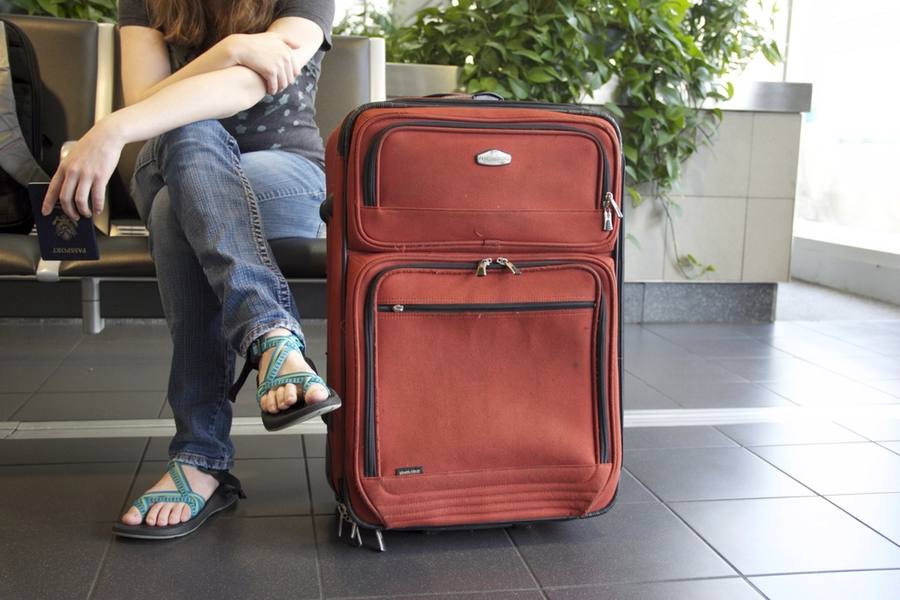
Soft Shell Wheeled Cabin Bag
Image illustrative (photo de stock) ; ce n'est pas le produit exact.
External Pockets Change How It Is Used
A hard case must be opened fully to reach anything, which at security or on a train is genuinely awkward.
External pockets hold a laptop, documents, a water bottle and a jacket accessibly, which for a bag used throughout a journey rather than only at either end matters considerably.
That accessibility is the strongest argument for soft luggage and the reason many frequent travellers prefer it despite hard shells protecting better.
It Compresses Into A Sizer
A soft case overpacked by a small margin can be squeezed into a sizer, where a hard case of the same nominal dimensions cannot.
That flexibility has saved a great many gate charges, and it is worth real money on airlines that check.
It also means a soft case can be slightly overfilled for a journey where it will not be measured, which a hard case physically cannot.
Protection Is Lower
Soft fabric absorbs impact and offers no crush resistance, which means anything fragile inside depends entirely on how it is packed.
For a cabin bag kept with you, that matters considerably less than for a hold case, since it is not being stacked under other luggage.
Liquids and anything that could leak are also a greater problem in a fabric case, since spills soak into the material rather than wiping off a shell.
Fabric And Durability
Ballistic nylon and high-denier fabrics resist abrasion far better than cheap polyester, which wears through at corners and along the base.
Water resistance varies, and a soft case in rain absorbs water through the fabric and the zip regardless of any coating.
A rain cover solves it entirely and packs to nothing, which for anybody travelling somewhere wet is worth carrying.
Stitching at stress points, particularly where handles and wheels attach, is where soft cases fail, and reinforced attachment points matter more than fabric grade.
Frame construction determines whether a soft case holds its shape when packed, since a bag with a rigid internal frame stands and packs like a case where a frameless one slumps and becomes awkward to fill. That frame adds weight, which is the trade, and a soft case with no structure at all is effectively a duffel with wheels attached.
Weight Advantage
Soft cases are generally lighter than hard shells of the same size, which on a cabin bag with a weight limit is directly useful.
That difference can be a kilogram or more, which is a kilogram of contents you can carry instead.
Very light soft cases achieve it by using thin fabric and minimal frames, which shortens their life considerably.
Telescopic handle quality is worth assessing by feel, since a handle with noticeable play rattles and wears, and one that sticks partway is an irritation every single time the bag is used. Twin-tube handles are considerably more rigid than single-tube ones and add a little weight, and the difference is immediately apparent when extending a handle on a loaded case.
The Verdict
The more practical cabin case for anybody using their bag throughout a journey, with accessible pockets and useful compressibility.
Protection is lower, fabric absorbs water and spills, and stitching at wheel and handle mounts is the failure point.
The compressibility is worth real money. A soft case squeezes into a sizer that a hard one of the same size will not.
En un coup d'œil
Avantages
- External pockets keep essentials accessible
- Compresses into a sizer a hard case fails
- Generally lighter than hard shells
- Absorbs impact rather than cracking
Inconvénients
- No crush protection for fragile contents
- Fabric absorbs water and spills
- Cheap polyester wears through at corners
- Stitching at wheel and handle mounts fails first
Questions fréquemment posées
Why choose soft over hard?
External pockets keeping a laptop, documents and a bottle accessible without opening the case, and compressibility that squeezes an overfull bag into a sizer a hard case fails. Both matter for a bag used throughout a journey.
How much protection do I lose?
Meaningful crush protection, since fabric absorbs impact but resists nothing. For a cabin bag kept with you that matters far less than for a hold case being stacked under other luggage.
What fails first?
Stitching where the handle and wheels attach, which takes all the load. Reinforced attachment points matter more than fabric grade, though cheap polyester also wears through at the corners and along the base.
Spécifications
| Type | Soft shell wheeled cabin bag |
| Key advantage | External pockets and compressibility |
| Sizer | Squeezes in where hard cases cannot |
| Protection | Lower; no crush resistance |
| Fabric | Ballistic nylon over cheap polyester |
| Water | Absorbs through fabric and zip |
| Failure point | Stitching at wheel and handle mounts |
| Weight | Generally lighter than hardshell |
Résumé
Pockets and compressibility are why frequent travellers prefer soft. Check the stitching at the wheel and handle mounts.
Vérifier le prix sur Amazon